
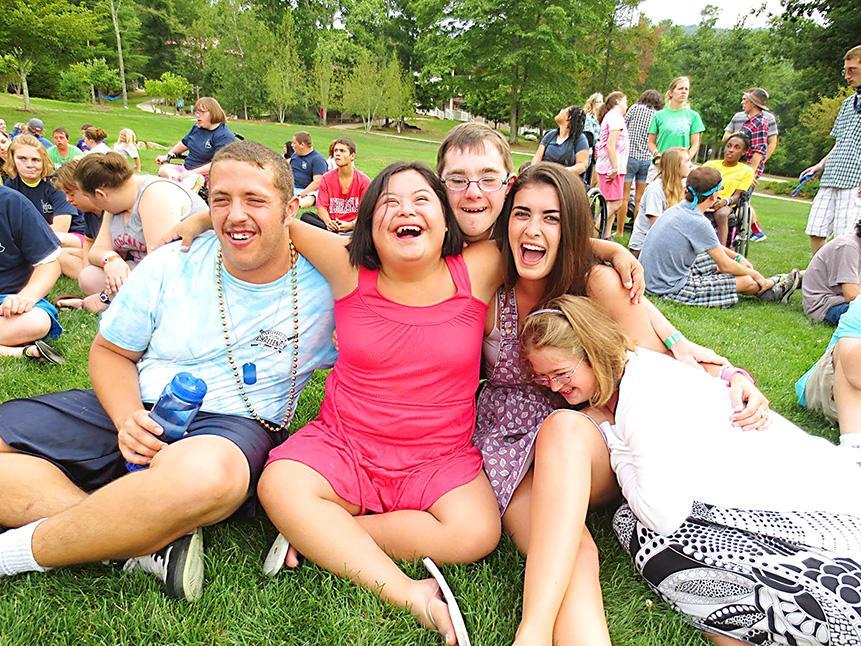
The Power of a Relationship
An article from University of Minnesota states that relationships can reduce stress and have been linked to overall improved health. Researchers have even shown that people with healthy social relationships have a 50 percent greater life expectancy. It further stated that loneliness is powerful enough to weaken our immune system. However, even with knowledge of these health statistics we find it hard to develop meaningful relationships with others.

So, let’s talk about meaningful relationships with people who have disabilities. Recently, social media as exploded with pop-up stories showcasing powerful friendships between two people: one with a disability and one without. For example, a story went viral recently of celebrity, Dwayne Johnson a.k.a “The Rock”, and his childhood friend Milton, who has Down Syndrome. Why do we as a society share and praise these “special” friendships on social media? Do we assume this is rare? Do we think that only a certain “type” of person who is patience and loving can develop a friendship to someone with a disability? My entire life when I tell someone I have a brother with a disability, that I was a Special Education teacher or that I have opened an organization to support those with disabilities, I get the same responses: “You must be a special person, “You must have a lot of patience”, and “I know I couldn’t do what you do.” I smile and say thank you, however I always think to myself, why do people assume relationships with individuals who have disabilities have to be difficult? Why do we place having relationships with individuals who may be different than us on an impersonal level? I have come to realize it is the fear of the unknown. It isn’t the fear of the person with the disability, it’s the fear society builds around the information and characteristics of disabilities. Because the fear of not knowing what to say, of doing something wrong, or feeling uncomfortable, the relationship is avoided all together.
To give you an example, you happen to see a former classmate in Wal-Mart and deep down you want to say “Hi, How are you? I haven’t seen you in years” but you don’t. Instead you may avoid the person and walk in the other direction without saying anything at all. You are fearful they might not remember or recognize you. See these fearful thoughts we embed in our minds are about us, and never about the other person. We fear being uncomfortable, or making the other person uncomfortable. I think this is how most people approach a relationship with those who are different from us, especially those with disabilities.

Studies have reported that people having disabilities are 50 percent more likely to report they are lonely compared to their peers without disabilities. They are not choosing to be lonely, but in some cases their social barriers and physical limitations make it more challenging for them to “make the first move” in building a friendship. Or if they make the first move, we may not take the time to realize the value in developing the relationship further. Like all people, disability or not, we all desire to be loved and accepted. It isn’t the lack of awareness about specific disabilities that holds us back to reaching out; not working beyond them, that’s the issue.
Forget “why” they are nonverbal. Forget that they look different. Forget the extra supports they may need. Forget the characteristics that make up their disability, because they do not define them. Personally my fear of offending someone is over shadowed by my desire to impact someone, so I take action. I forget all that I just mentioned and start with the basics: find an interest, observe their environment to learn, ask questions to gain knowledge, and adjust my pace to understand their way of communicating. If another person’s health is directly linked to their loneliness, we should eliminate these fears of the unknown by taking action to connect with someone today.
Sometimes the most powerful impact we have on our own lives, isn’t the friendship with someone that is like us, but the friendships with those who are different from us. We limit ourselves to certain perspectives about life, a finite level of understanding about people when we only build relationships with people who make us feel comfortable.

Society’s awareness has certainly progressed in embracing individuals with disabilities but let’s not stop there, let’s build on that momentum! The motherly motto, “Treat others the way you want to be treated”, isn’t enough. We must be intentional. We do that by taking the first steps in building a relationship centered on love, acceptance, and caring enough to meet the other person on their level. Don’t let fear stop you, don’t think you have to know all the right things to say, just make the first move and say the one thing we all know and that is, Hi. That’s the first step off the sidelines.
My “Imprint”
So, with every article I write and blog post I make, I want to leave a traditional mark that is considered my “imprint”. The takeaway nuggets I want my readers to have as it pertains to their role they play in the lives of those with disabilities.
Parents: don’t wish for or hope for friendships for your loved ones; help become the bridge of not just making your loved one comfortable, but their peer just as comfortable. Don’t assume their peer knows how or wait for them to show interest, just dig in and connect and see what happens.
Teachers: use every opportunity in each class, hallway, club, and sport to teach and model the steps of relationships between two people that may not take the time to connect. Don’t expect and/or wait for this to happen naturally. Help them to find the words to share, and shape the connection along the way. Get out of your comfort zone to make magical relationships happen in and outside of your classroom. Be intentional.
Community Member: the power of change starts with each of us taking actions which will result in a ripple of effect. Don’t let the fear of not doing it right, or waiting for the perfect time to have all the right information to happen before you build a relationship. Don’t think you don’t play a role in other people’s lives, you make it your role.